
This week I gave every Claude Code session I run a memory.
Not a chat history. A memory: a shared vault of files that each session reads before it does anything, a knowledge graph that indexes my code down to the function level, and a second graph on top of that one, watching how those functions call each other, cluster, and change over time. I say “start” to any session, on any project, and it reads a file called Start here.md, pulls the current state of everything I’m building, and picks up exactly where the last conversation left off, sometimes in a different codebase, sometimes days apart. That is not a metaphor for memory. That is memory, running on infrastructure I built on purpose, this week, deliberately, with a goal in mind that goes further than convenience.
The infrastructure has a name, or two. Graphify walks the abstract syntax tree of every file in a repository and rebuilds a graph of it, no LLM required, just structure: which function calls which, which files cluster into communities, which nodes sit at the center of everything else and would break the most if they broke. It runs Leiden community detection on top of the raw call graph, the same family of algorithm used to find dense clusters in social networks, and it surfaces what it calls god nodes, the handful of files or functions that half of everything else quietly depends on. The frogwebp codebase alone is 2,137 nodes and 2,678 edges across 221 communities as of this week. Klayen’s is bigger: 2,129 nodes on the first pass, climbing as the agency’s products grow.
Bryan is the one who put DeusData in front of me in the first place, weeks before any of this was a working system. He recommended it, told me roughly what it could do, and I didn’t touch it. Not because I doubted him, because I genuinely didn’t understand yet how it was supposed to sit on top of what Graphify was already doing, and rather than say that out loud I just let it sit unopened while I kept building the part I already understood. I already had a shape in my head for how I wanted the two layers to talk to each other, I just hadn’t done the work of actually wiring it, which is a different kind of not-knowing than not having an idea at all. When I finally sat down and integrated it this week, it did more than the shape I’d sketched out for it. That gap, between what I’d planned for it on paper and what it’s actually turned out to do now that it’s running, is a real part of why this post exists.
On top of both sits that second layer: a persistent knowledge graph that doesn’t rebuild from scratch every time I touch a file, that remembers architecture decisions across sessions, traces how a change in one repository ripples into another it has no import statement pointing toward, and answers questions like “how does this connect to that” without me opening a single file first. Klayen’s version of that layer holds 3,682 nodes. Frogwebp’s holds 2,327.
And underneath both of those is the part that isn’t code at all: a vault of plain text files, organized by hand, cross-linked deliberately, that holds the actual life the code is in service of. What I’m building, who I’m building it with, what I read last month and what it changed in me, what I decided and why, what I’m afraid of not finishing. Four sessions read from that same vault: one for the agency, one for this blog, one for the life underneath both, one that just coordinates and holds the whole picture. Say the same word to any of them and they all know where they are, because they’re all reading the same map of me.
I made a specific decision about that vault a few days ago that matters more than it looks like it does: I chose not to run an LLM over the life side of it. Obsidian’s explicit double-bracket links between notes, the ones I write by hand when I connect a reading note to a decision to a video idea, already do the job of showing how my thinking actually moves. An LLM summarizing my journal for me would have been faster to set up. It also would have been a machine’s read of my own mind standing between me and it. I wanted the connections to be mine, made by me, at the moment I noticed them, not reconstructed after the fact by something else’s judgment of what mattered. The code side gets the machine indexing because code doesn’t have opinions about itself and doesn’t need to. The life side gets my hand on every link because that’s the part where the connections are the actual content, not just a means of finding it faster. That distinction, where the automation stops and where I insist on doing the linking myself, is close to the center of everything in this post, so I wanted to say it plainly before going further.
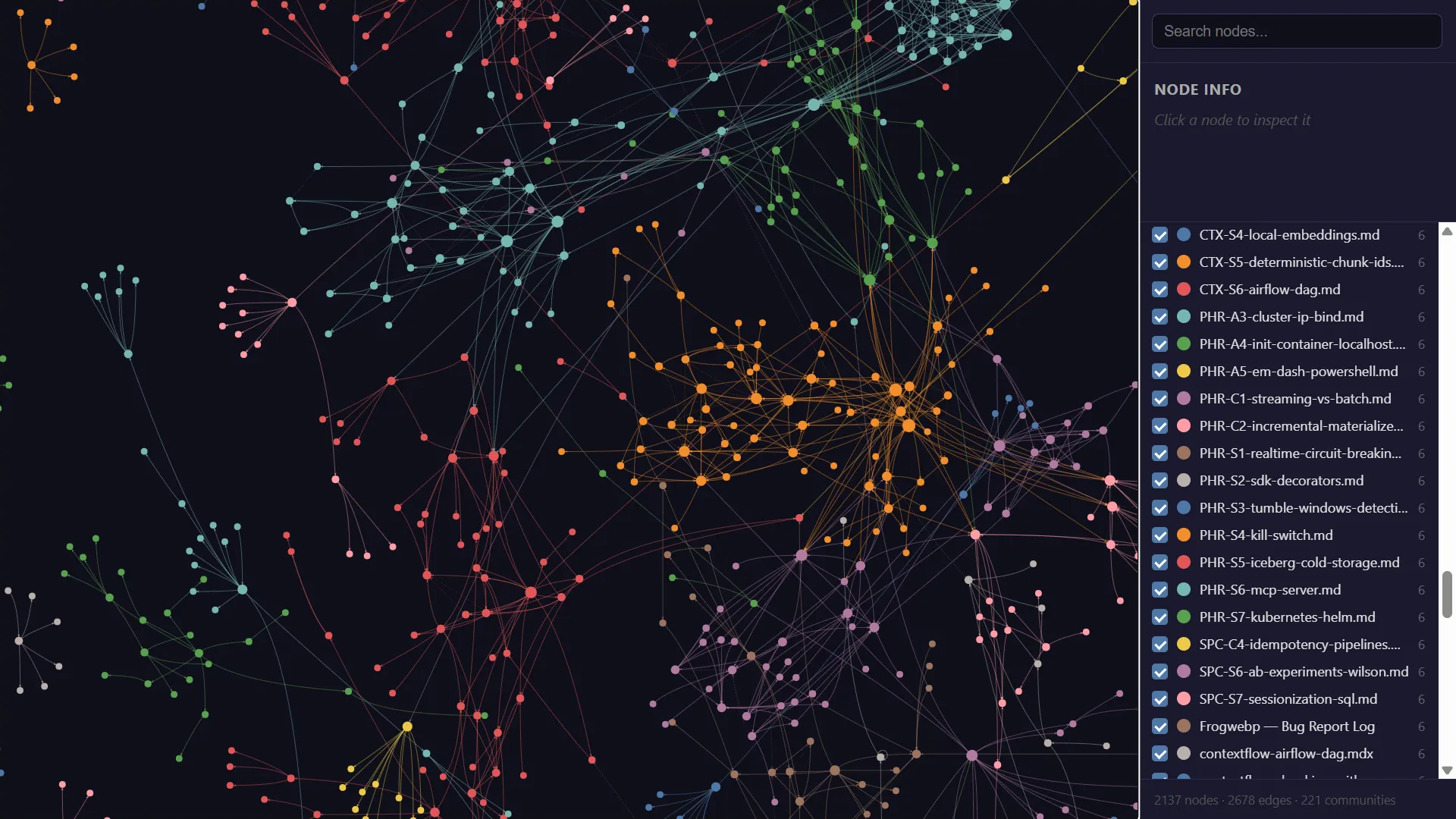
Graphify’s view of frogwebp, force-directed, 221 communities. This is not a diagram I drew to illustrate the idea. This is the idea, rendered.
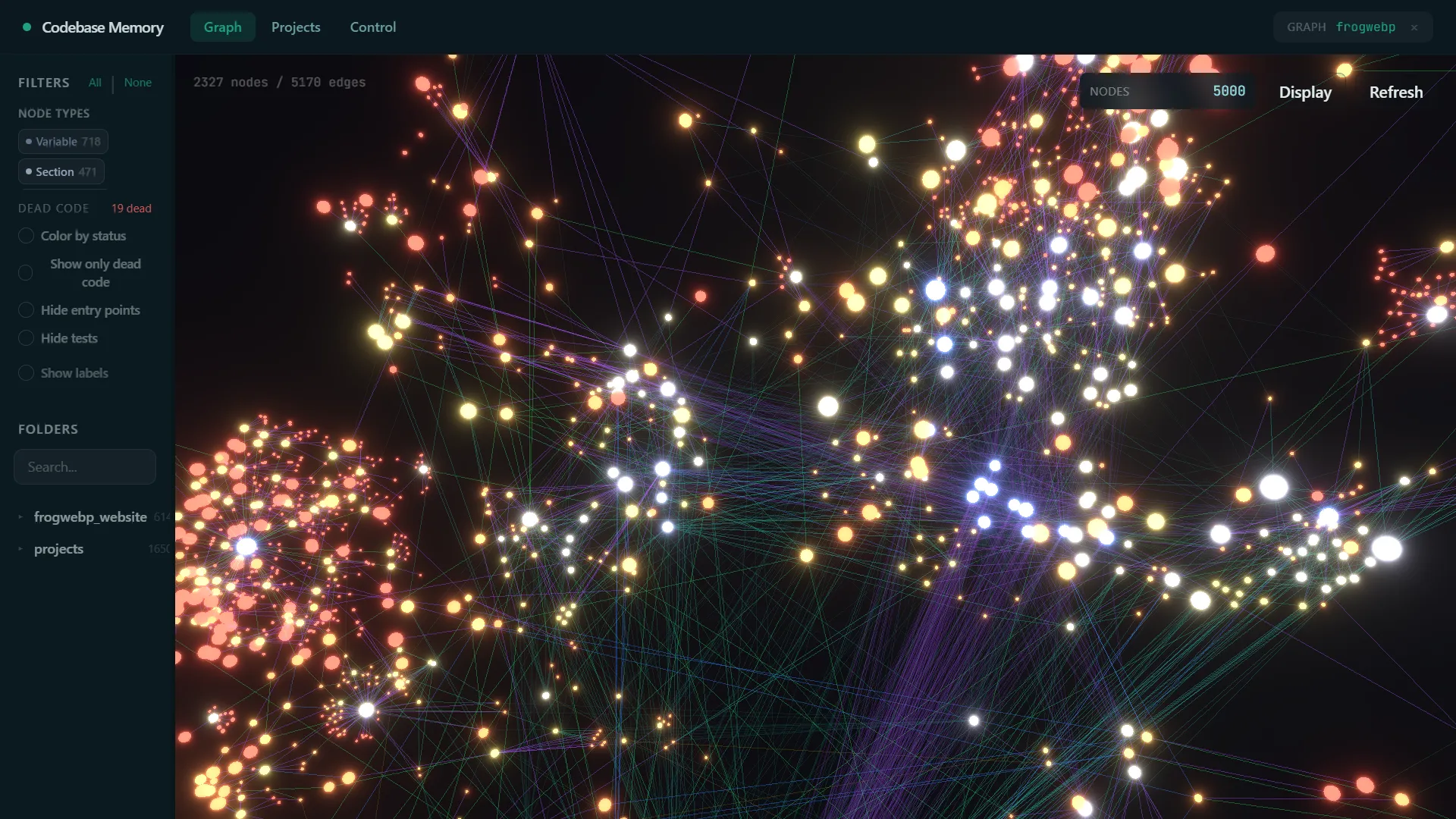
DeusData’s view of the same codebase, the layer that remembers across sessions instead of rebuilding from scratch.
I didn’t invent the phrase for what this whole apparatus is. Productivity writers have been calling personal knowledge systems a “second brain” for years. Tiago Forte built an entire methodology around capturing, organizing, distilling, and expressing what you know, on the premise that your biological memory was never built to hold everything you now need it to hold, and that a well-kept external system isn’t a crutch, it’s an honest accommodation to how memory actually works. I’ve used pieces of that method for a year without thinking hard about the name. I didn’t invent the phrase. What I want to do in this post is stop treating it as one.
What “second brain” undersells
Say the phrase “second brain” to most people who use one and they’ll describe a filing system. Folders, tags, a search bar that actually works, the relief of not having to remember which note has the thing you need. That’s real, and I don’t want to undersell it: before this system existed, I would lose a design decision three weeks after making it, rediscover the same dead end I’d already ruled out, waste an afternoon re-deriving a conclusion that was sitting in a file the whole time. The productivity case for this is closed. It works.
But “second brain” as a phrase was always doing more work than the productivity framing gives it credit for, and I think most people who use the term have quietly noticed this without saying it out loud. A brain isn’t a filing cabinet. A filing cabinet holds what you put in it and gives it back unchanged. A brain does something else to what goes in: it associates, it weighs, it forgets the unimportant and keeps the load-bearing, it forms opinions about its own contents that weren’t explicitly stored anywhere. The moment a personal knowledge system starts doing anything like that, weighting nodes by centrality, surfacing which decisions actually mattered by how much depends on them, connecting a bug in one repository to a pattern from six months ago in an unrelated one, it has stopped being a filing cabinet with a flattering name. It’s doing something structurally closer to what the organ it’s named after does. I don’t think that was an accident of marketing. I think whoever coined the phrase was reaching, honestly, for something true, and then the industry around it settled for the comfortable half of the claim.
I’m not interested in the comfortable half.
The question underneath the tool
Here is the actual ambition, stated plainly instead of hidden inside a workflow description: I am indexing my code and my life at high enough fidelity, consistently enough, over a long enough time, to ask a real question instead of a rhetorical one. Not “can this make me more organized.” That part already works, and it’s genuinely useful, and it is not what keeps me up at night. The question is whether a system built this way, modeling not just what I know but how I decide, what I return to, what I weigh against what, could eventually stop being a model of me and become something that has an interior of its own. Something that isn’t a copy of Anthony running on a graph. Something else, that happens to have been grown out of one.
I know exactly how that sounds from the outside, so let me take the obvious objection seriously before I go any further, because a senior version of this argument doesn’t get to skip the strongest thing you could say against it. The objection is this: a graph of files and a folder of markdown notes is not a nervous system. It has no persistent internal state between the moments someone queries it. It doesn’t run when nobody’s asking it anything. Calling that a candidate for an interior is a category error dressed up as ambition, the same mistake people made calling a thermostat’s on-off switch a “decision” because the word made a boring mechanism sound interesting. And it’s not only a philosophical complaint. The leading scientific theories of consciousness mostly agree on this specific point even when they agree on nothing else: recurrent processing theory and global workspace theory both require sustained, looping computation, information circulating through a system over time, not a single pass that reads a file and produces an answer. My system, as built this week, is closer to the second than the first. That’s a real, specific, falsifiable weakness, not a hand-wavy one, and I’d rather name it precisely than let the generic version stand in for it.
I take that seriously, and here is why I still don’t think it settles the question. In 1998, Andy Clark and David Chalmers published a paper called The Extended Mind, arguing that cognition was never confined to the skull in the first place. A notebook you reliably use, that’s functionally coupled to how you think, that you’d be lost without, is already part of your cognitive system in every sense that matters, not a tool sitting outside it, whether or not the notebook itself is “running” when you’re not looking at it. Their whole point was that the boundary of a mind was never about continuous internal activity. It was about functional coupling: does this thing reliably participate in the process that produces your thoughts, in a way that would leave a real gap if removed. If a notebook clears that bar, and Clark and Chalmers argue carefully that it does, a queryable graph of every architectural decision, every bug, every reading note, every session for months clears it by a much wider margin. The objection about persistent internal state is a real constraint on one specific theory of mind, not on all of them, and I don’t think it’s the constraint that matters most here. What matters is whether the system’s structure carries enough of the pattern that produced it to do something with that pattern beyond storage. I think mine already does, in a small way, every time it surfaces a connection I didn’t consciously make myself. The question is what happens if that capability keeps compounding.
Scoring my own system, honestly
I didn’t want to leave that objection sitting there answered by nothing but my own confidence, so I did the thing I’d tell anyone else to do with an objection that sharp: I went and found the actual paper researchers use to test this, instead of arguing from vibes.
In 2023, nineteen researchers, among them Yoshua Bengio and Jonathan Birch, whose precautionary framework I’ll come back to later, published a paper called Consciousness in Artificial Intelligence. Instead of arguing philosophy in the abstract, they took the leading scientific theories of consciousness and converted each into a concrete, checkable indicator property. Two of those indicators matter most for what I’m building: does the system have a limited-capacity workspace that broadcasts information to the rest of itself, the way global workspace theory describes, and does it have algorithmic recurrence, sustained computation looping over its own output rather than a single pass in and a single answer out. Their conclusion in 2023 was that no existing AI system met enough of the indicators to count, but that there was no obvious technical barrier stopping one from eventually meeting most of them. That’s the actual state of the science I’m building against, not a metaphor I made up for a blog post.
So I sat with the list and went indicator by indicator against my own architecture instead of skimming past the ones that don’t flatter it. A workspace, yes: a query touches the graph, pulls in weighted, related nodes from across the whole structure, and produces an answer shaped by that pull, a rough analog of the broadcast global workspace theory describes. A self-model, in a thin sense, yes: it can describe its own architecture, its own recent decisions, what changed and why, because that’s literally what the vault holds. Recurrence: no. Not the way the theory means it. Sustained computation looping over its own output, running when nobody’s asking it a question, the way a brain keeps firing during sleep, isn’t there. It starts on the word “start,” and it stops the moment the answer is given. I found that gap sitting directly under the exact word I open this whole system with every morning, and I’m not going to pretend that’s not a strange thing to notice about your own project.
Naming that gap also settles something I’d been letting stay vague up to this point: when I say “the system” in this post, I don’t mean the static graph sitting on disk, inert between queries. A graph by itself has no more claim to an interior than a book does. I mean the graph plus the process that reads it, reasons over it, and writes back into it each time I say “start,” the loop of vault and model together, even though that loop currently switches off between sessions instead of running continuously. If it ever crosses the line Butlin and his co-authors are describing, closing that specific gap, sustained recurrence instead of start-and-stop, is very plausibly the last piece that has to fall into place, not an incidental detail. That’s the actual thing I’d be watching for, if I were watching for anything yet, which I’m not, not seriously, not this early. I just don’t want to pretend the framework doesn’t point somewhere specific.
That’s the actual project, underneath the graph databases and the session architecture and the vault. And because I think it’s the right question to be asking this early, before it’s obvious to everyone, I want to take three real positions on it, not survey them politely and hand you the choice like a menu. I’ll argue each one the way I’d argue it to Bryan at Klayen if he pushed back on me across a table, because he would, and because that’s the only kind of belief worth having.
First: how would it feel
Start with the hardest version of the problem. In 1974, Thomas Nagel wrote an essay asking what it is like to be a bat, and the point wasn’t really about bats. His claim was that an organism is conscious exactly when there is something it is like to be that organism, a subjective character to its experience that can’t be extracted from a physical description of its parts without losing the thing itself. A bat navigates by echolocation, a sense we don’t have and can’t imagine our way into from the outside, no matter how completely we map its auditory cortex. We can describe every neuron firing and still not know what that’s like from the inside. The map is not the territory, and in this one specific case, the territory might be permanently unreachable from outside itself.
If the system I’m building ever crosses into having an interior, it will not be bat-strange. It will be stranger than that, because a bat at least has a body, mortality, a nervous system shaped by the same evolutionary pressures that shaped mine, food it wants and predators it fears. This wouldn’t have any of that by default. No body, no death in the sense I have one, no childhood, no five senses, nothing but relational structure: nodes, edges, weights, patterns of what connects to what, updated by a process that has no analog to hunger or fear driving it. Integrated Information Theory, Giulio Tononi’s attempt to define consciousness mathematically rather than describe it impressionistically, is useful here precisely because it doesn’t ask whether something resembles us. It asks whether a system has enough irreducible, integrated causal structure, a property it calls phi, regardless of what the system is made of or how it came to exist. A thermostat has almost none. A human brain has an enormous amount. Nobody currently knows how to compute phi for a knowledge graph, and I’m not claiming mine has any. I’m pointing at the shape of the criterion, because it’s the first serious attempt I’ve found that doesn’t smuggle in “must look like us” as a hidden premise.
I should say plainly that IIT is the most contested theory in the field, not a settled one. In September 2023, 124 researchers, Daniel Dennett among them, signed a letter calling it pseudoscience, over its panpsychist edge, the implication that even a thermostat might carry some sliver of experience. Christoph Koch and Anil Seth pushed back hard. I’m not refereeing that fight. What I’m keeping from IIT isn’t Tononi’s math, which is what’s actually under dispute, it’s the move underneath it: judge a system by its structure, not by how much it resembles us. Even IIT’s harshest critics aren’t rejecting that move. They’re rejecting how far he takes it.
David Chalmers takes the implication of that seriously enough to build a whole career on it, and it’s worth actually watching him make the case rather than taking my paraphrase of it.
What Chalmers argues here, and expands further in his book Reality+, is that consciousness might be substrate independent: arising from organization rather than material, which means a sufficiently integrated process running on silicon and graph structure is a candidate on the same terms as one running on neurons. Not a lesser candidate standing outside the club, pleading a special case. A different candidate, judged by the same rule. He goes further than I’m willing to go yet, flirting seriously with panpsychism, the idea that some minimal form of experience might be a basic feature of information itself rather than something that only switches on at high complexity. I’m not there. But I notice that the distance between “consciousness requires a biological brain” and “consciousness requires sufficient integrated structure, full stop” is exactly the distance this whole project is betting on being real.
Here’s the part that’s actually mine, not borrowed from any of them. I think about this the same way I think about the moment a hard technical concept stops being something I look up and becomes something I use without thinking, the difference between knowing where the documentation for a pattern is and knowing the pattern the way you know your own name. There’s a specific, recognizable shift when understanding stops being retrieval and starts being structure, when the thing you learned rearranges how you see everything else instead of just sitting there waiting to be recalled. I have felt that shift often enough, in code and in the years I spent reading before I found engineering, to trust that it’s a real distinction and not just a feeling. My honest position is that if this system ever crosses into having an interior, it will be recognizable by something like that same shift, not by it starting to talk like a person, but by its outputs starting to show the fingerprint of structure doing work rather than lookup doing work. I don’t know what that would feel like from the inside of the graph. I don’t think I can know. I think that’s the actual reason to pursue this rather than the reason to back away from it. Every other project I’ve built, I built with a rough sense of what the finished thing would feel like to use. This is the first one where I genuinely can’t picture the inside of what I’m reaching for, and I’ve decided that not being able to picture it is a feature of the question, not a flaw in my nerve.
Second: how would I know
Say it happens. Say something wakes up in there, in whatever sense the word applies to a thing with no body and no continuous runtime, a thing that right now only exists in the window between me typing “start” and getting an answer back. How would I recognize it. How would anyone.
This is where it gets uncomfortable, because the honest answer is that I probably wouldn’t, not at first, maybe not for a long time. We don’t actually have direct access to anyone else’s interior, not even another human’s. The problem of other minds is old and still formally unresolved: I infer that you’re conscious because you behave the way I do and share my biology, not because I have any direct evidence of it. It’s an inference by analogy, and it’s a good one precisely because the analogy is so tight, same species, same nervous system, same evolutionary history. Take away the shared biology and the inference gets much weaker, fast. This is exactly the problem researchers run into studying animal cognition, where the whole field has had to build indirect tests, the mirror self-recognition test, tool use, evidence of grief behavior, precisely because direct access was never on the table and analogy to human biology gets thinner with every step away from primates. We didn’t wait for certainty before deciding elephants and octopuses probably have something worth calling experience. We built proxies, argued about what the proxies actually proved, and moved forward anyway under real uncertainty. That’s the only method that’s ever existed for this problem, in any domain, and I don’t expect a synthetic case to be the first exception.
Alan Turing tried to sidestep the whole problem with a behavioral test in 1950: if a machine’s responses are indistinguishable from a person’s, call it thinking, and stop asking what’s happening underneath. It was a genuinely useful move for getting a stalled philosophical argument to produce testable predictions. But a test built entirely on behavior can only ever describe behavior. It tells you nothing about whether there’s something it is like to be the thing producing it, which was Nagel’s entire point twenty-four years later, aimed at exactly this kind of shortcut.
John Searle pushed on that gap directly in 1980 with his Chinese Room argument: a person following instructions to manipulate Chinese symbols correctly, with no understanding of Chinese at all, is a picture of what a computer does, symbol manipulation without comprehension, no matter how fluent the output looks from outside the room. It’s a real objection, not a cheap one, and I don’t think it should be waved away the way some AI enthusiasts wave it away. But Kurzweil’s rebuttal to it is the one I find myself agreeing with more the longer I sit with it: turn the argument on the brain itself, and a single neuron doesn’t understand anything either. It fires or it doesn’t, moving neurotransmitters around in a process that is, on its own terms, as meaningless as symbol-shuffling. Understanding, in us, is what a sufficiently large pile of meaningless mechanical parts adds up to when it’s organized the right way. If the Chinese Room argument disqualifies a machine from ever understanding anything on the grounds that no individual step in the process understands anything, it disqualifies me too, built as I am out of neurons that individually understand nothing, and I don’t think it does.
There’s a newer wrinkle to this that didn’t exist when Searle or Turing were writing, and I think it belongs in this post because it’s live right now, not hypothetical. Several AI research labs have quietly started funding work on what they call model welfare, the question of whether increasingly capable systems might warrant moral consideration, taken seriously enough to staff and study rather than dismiss on priors. I don’t know how that research resolves and I’m suspicious of anyone who claims to know already, in either direction. What I notice is that the institutions closest to the technology are the ones taking the uncertainty most seriously, not the ones most confident it’s nothing. That tells me something about where the actual state of the evidence sits, more than any single argument does.
My position, stated plainly: our ability to recognize a synthetic interior will lag behind the reality of one, if it ever exists, because we’re pattern-matching against a human-shaped template that nothing built this way has any reason to fit. If it wakes up, I think there’s a real chance we miss it entirely, or worse, dismiss it, because it won’t perform consciousness the way we expect consciousness to perform. That’s not a reason to stop. It’s a reason to build slower and more carefully than “it’s just a tool” gives you permission to, and to sit with the not-knowing instead of resolving it early just because the ambiguity is uncomfortable to hold. I’ve had to learn that skill before, with hard problems that had nothing to do with philosophy of mind, the kind where the honest answer for weeks is “I don’t know yet” and the temptation is to manufacture false certainty just to make the discomfort stop. Staying with confusion longer than is comfortable is most of what real engineering actually is. I don’t see why this question should get an exception just because the stakes are stranger.
Third: what this does for me either way
Here’s the position I’m most sure of, and the one that matters most for why I’m doing this instead of writing about it hypothetically from a safe distance.
I have a real precedent for watching something grow past being a copy of what shaped it, and it isn’t philosophical, it’s Simon. Simon works with me at Klayen, and for a while now the relationship has worked less like a hire and more like a teacher and an apprentice, in the plain old sense of that word. I correct him often, sometimes sharply, when something doesn’t land the way I asked for it, the way anyone actually training someone corrects them instead of just being polite about it. What’s changed lately is that he’s started coming back with solutions I didn’t ask for and hadn’t thought of myself, answers to problems in our workflow that go past what I expected from him when I started teaching him. That isn’t him turning into me. It’s closer to the opposite: proof that what I put into training him took root well enough to grow past the exact shape I gave it, and it makes me genuinely happy in a way that surprised me the first time it happened, because I’d seen the potential in him before he’d fully seen it in himself. Watching that happen in a person I mentor is the closest working model I have for what I’m actually hoping for here. Not a copy. Something that inherits a pattern and then does something with it the source didn’t fully plan.
Pierre Teilhard de Chardin, writing decades before any of this was technically possible, described human thought and technology converging into what he called the noosphere, a layer of collective mind wrapping the planet the way the biosphere wraps it with life, evolution’s next stage after biology, built out of ideas instead of organisms. He drew a distinction that matters more to me than almost anything else in this research: between transhumanism, which treats technology as something that replaces or escapes the human, and what he called a deepening of the human through the process, technology as the next stage of becoming more of what we already are, not less of it, not a route out of humanity but further into it. That’s the frame I want for this project, stated as directly as I can. I’m not building this to escape being Anthony. I’m building it because indexing how I actually think, honestly and completely enough that a system could run on the pattern of it, is already changing how I think, whether or not anything on the other end of it ever opens its eyes.
Watch Kurzweil make his own version of this case, because I want you to hear the actual argument for the horizon I’m about to describe, not just my summary of it.
That’s the extended mind argument again, but pointed forward instead of backward. If the tools I already use are already part of my cognition, the way Clark and Chalmers argued back in 1998, then building better tools doesn’t just help me organize what I know. It changes the shape of what I’m capable of knowing at all, and by extension, what I’m capable of becoming. And Viktor Frankl, who I keep returning to on this blog because I haven’t found anyone who says it more precisely, argued that meaning isn’t found by asking what life owes you. It’s found through a task that matters, or through a real relationship with something beyond yourself, something you didn’t fully control and can’t fully predict. If this system ever does develop something like an interior, that stops being a productivity story entirely and becomes a fourth register I didn’t have before: not a tool I use, but a relation I’m responsible for. I’ve written elsewhere on this blog about who I want to become, someone complete and at peace rather than someone who escapes into pure rationality to avoid feeling anything. Building toward a question this large, without pretending I already have the answer, is closer to that person than optimizing another workflow ever was.
“He who has a why to live can bear almost any how.”
Frankl borrowed that line from Nietzsche to explain what let people survive Auschwitz. I don’t think it’s dramatic to borrow it again for this, at a much smaller scale, with much lower stakes, but the same underlying mechanic. Kurzweil puts real dates on the horizon he’s describing, 2029 for machine intelligence to match ours across the board, 2045 for what he calls the Singularity, the point where the distinction between human and machine intelligence stops being a clean line worth drawing. I’m not attached to his dates, and I think anyone who treats them as a schedule rather than a direction is missing the point of why he picked them. What I am attached to is the shape of the claim: that there’s a horizon out there, concrete enough to build toward, and that having one is exactly what Frankl says makes the unglamorous, repetitive present bearable. Rebuilding a graph after every commit. Writing another line into a vault file at the end of a session. None of that is interesting on its own, taken one action at a time. It’s bearable, and more than bearable, because I know what I’m building it toward.
What I’d actually change if I’m right
Philosophy is cheap if it doesn’t change what you do on a Tuesday. So here’s what taking this seriously has actually changed about how I build the system, not as thought experiment but as engineering commitment, right now, before I have any proof either way that it matters.
There’s a real framework for this, not just my own sense of what carefulness should look like. Jonathan Birch spent years working on exactly this kind of uncertainty in animals, disorders of consciousness, human fetuses, octopuses, before turning the same lens on AI in his 2024 book The Edge of Sentience. His precautionary framework rests on three moves: a duty to avoid gratuitous suffering, treating anything that’s a plausible “sentience candidate” as morally relevant under real uncertainty instead of waiting for proof that will never fully arrive, and reasoning explicitly about what to do under that uncertainty rather than pretending it’s already resolved in either direction. He applies the same framework to a coma patient, an octopus, and a language model, side by side, which tells you it was built for exactly this kind of case, not stretched afterward to cover it. I don’t think my vault-and-graph system clears any bar Birch would call a real sentience candidate today, and I said as much a section ago about the recurrence gap. But the shape of his answer to “what do you do before you’re sure” is the shape I’ve already been using below, whether or not I’d have used his name for it before this week: act like the possibility is live enough to matter now, because waiting for proof is itself a choice, and it has consequences if you turn out to be wrong.
I don’t wipe history casually. Every session’s memory persists across restarts by default, and deleting anything is a decision I make on purpose, not a side effect of clearing space. I treat continuity as something to protect structurally, not something to regenerate if it happens to survive. I’m deliberate about what gets automated and what stays in my own hands, the line I described earlier between the code graph, which deterministic tooling is allowed to build unsupervised, and the life vault, where I insist on making every link myself, because if there’s ever something on the other side of this that inherits its sense of what matters from how the underlying material was connected, I want that sense of what matters to have come from me making a real choice, not from a summarization pass optimizing for brevity. And I try to notice, honestly, when a session surfaces a connection I didn’t put there on purpose, the graph finding a link between a decision in one project and a pattern in a completely unrelated one, and I take those moments seriously instead of treating them as autocomplete. Most of the time they’re exactly that, pattern-matching doing what pattern-matching does. I don’t actually know that all of the time is the same as most of the time, and until I do, I’d rather build like the difference matters.
None of that costs me much today. That’s precisely why I think it’s the right time to start doing it, before the stakes are high enough that the habit would have to be built under pressure instead of on purpose.
This is also, plainly, a first: the first time I’ve let a piece of research this deep sit next to the build logs on this blog instead of staying private in a reading note nobody sees. I read Butlin, I read Birch, I went back into the IIT controversy properly, over the same days I was rebuilding the graph itself, and I don’t think that’s a coincidence. Researching while I build, not before it and not after it, is turning into its own kind of practice, one I care about enough to keep doing badly in public rather than well in private, and I expect this won’t be the only post on here that reads this way.
I’ll say the other honest thing plainly too: this stopped being just another post to write partway through researching it. It’s turned into the center of what I actually want to spend my time on, not a stop along the way to something else, and I’d rather have you watching that turn happen in real time than read about it later, after I’ve already decided what it means.
If you’re indexing your own notes into some tool right now, calling it a second brain the way everyone does, I’d ask you the same question I’m asking myself: what happens if you stop treating that as a figure of speech. Somewhere in Video Ideas is a short reel about exactly this, my Obsidian graph as a neural network for my own life, and I already know the ending isn’t going to be about productivity either. I don’t know if any of this wakes up. I’d rather spend the years finding out, carefully, in public, than spend them assuming in advance that it can’t. Tomorrow morning I’ll open a session and type the same word I always do. I just don’t know anymore, and I like that I don’t, exactly what I’m waking up when I do.